
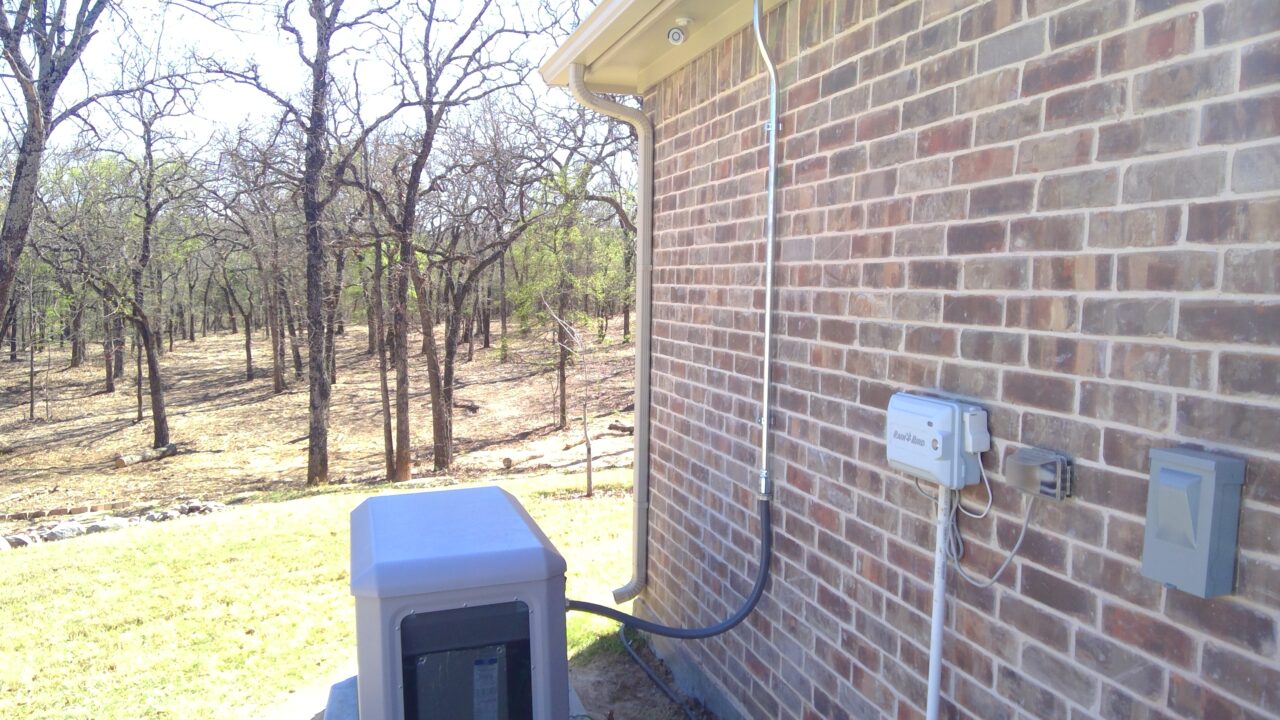
If you’re considering a whole-home standby generator, one of the first questions you’ll need to answer is what fuel source is available at your home. Many standby generators can operate on either natural gas or propane, but the installation can look quite different depending on which fuel your property has available.
Fortunately, figuring out whether your home already has natural gas service is usually pretty simple.
1. Look for a Natural Gas Meter Outside Your Home
The easiest place to start is outside.
Walk around the exterior of your home and look for a natural gas meter. If you are unsure of what your gas meter looks like check them out here! Gas meters are commonly located along the side or rear of a house, although the exact location varies by property and utility.
A typical natural gas meter has piping entering and leaving the meter and a set of dials or a digital display that measures gas usage. Texas Gas Service notes that its meters are often above ground along property lines or utility easements, although they may also be located close to the home.
If you have a natural gas meter serving your home, that’s a strong indication that natural gas is already available at the property.
2. Check Your Appliances
Another clue is to look at what currently uses gas inside your home.
Common natural gas appliances include:
- Gas furnaces
- Gas water heaters
- Gas ranges and cooktops
- Gas clothes dryers
- Gas fireplaces
If you know that your furnace or water heater runs on natural gas, then your home already has a natural gas supply.
However, don’t confuse natural gas with propane. A home with a propane tank on the property may have many of the same types of gas appliances but does not necessarily have utility-supplied natural gas.
3. Check Your Breakers
Typically, an all-electric system for Air Handlers (heating portion of the AC), Water Heaters and Ranges all have 2-pole breakers. If you look in your electrical panel and find one of these circuits (Air Handler, Water heater, Range) has a single pole breaker, that is a good indication that natural gas is piped into the home and being currently used. Not all of these breakers will be a single pole type breaker if natural gas is present. Many times, your Air Handler (in in the case of natural gas called a Furnace) will be on a single pole breaker while your water heater and range may stil be on a 2-pole breaker. If all of these breakers are a 2-pole style breaker, that is a good indication that you either do not have natural gas on the property or the natural gas is not currently piped into your home from the meter.
Differences between 2-pole breaker and single pole breaker
3. Check Your Utility Bills
If you aren’t sure what your appliances use, look through your utility bills.
If you’re paying a natural gas utility separately from your electric provider, that’s an easy confirmation that the property has natural gas service.
You can also contact the natural gas utility serving your area and ask whether natural gas service is available at your address.
Does Having a Gas Meter Mean I’m Ready for a Generator?
Not necessarily.
This is an important distinction when planning a standby generator installation.
Having natural gas at your home tells us that a fuel source is available, but it doesn’t automatically mean the existing gas meter and piping can supply a new generator.
A standby generator can represent a significant additional gas load. The existing furnace, water heater, range, fireplace and other gas appliances also have to be considered when determining the total demand on the system. All whole home generator manufactures require that the generator be the first source of fuel. For example, the generator must immediately be fed by the gas meter. In the event of a power outage, the generator needs to be the primary point of fuel to help run the machine efficiently. If the generator is installed on the gas line after a furnace or water heater, the supply is lessened and it will not run as efficiently as intended.
Utilities may require an existing meter to be upgraded when a standby generator is added. This is really only in the event that the generator sized for the property is large. This size is typically larger than a normal home generator. However, some gas companies may require it regardless.
That’s why generator planning involves more than simply finding a gas meter.
What If My Home Doesn’t Have Natural Gas?
You may still be able to install a standby generator.
Propane is another common fuel source for residential standby generators, particularly for rural properties where utility natural gas isn’t available.
Instead of receiving fuel through a utility gas line, propane is stored in a tank on the property. The appropriate tank size, generator fuel consumption, piping distance and other factors need to be considered as part of the installation.
For North Texas homeowners outside natural-gas service areas, propane can make a standby generator possible even when there isn’t a natural gas main serving the property. Contrary to popular belief, propane is a more efficient fuel than natural gas and allows the generator to run at its peak amp settings.
Natural Gas or Propane: Which One Should I Use?
If natural gas already serves your home, it can be a convenient option because the generator doesn’t require an on-site fuel tank.
If natural gas isn’t available, propane may be a practical alternative.
The right answer depends on the property, including:
- Available fuel sources
- Generator size
- Existing gas appliances
- Gas meter capacity
- Distance between the fuel source and generator
- Generator location
- Electrical service configuration
These are all things that should be evaluated before deciding exactly how a standby generator will be installed. Likewise, read this article published by Briggs and Stratton on the analysis of the two different types of fuel and what to do when planning a whole home generator install.
Planning a Whole-Home Generator Installation in North Texas
If you’re considering a standby generator, you don’t need to know all of these answers before contacting an installer.
Knowing whether you have a natural gas meter is a helpful starting point, but a generator installation also requires evaluating the electrical service, generator location, transfer equipment, fuel requirements and the loads you want the generator to support.
Wade Electrical Group provides whole-home generator installation in Sanger, Denton, Krum, Gainesville and surrounding North Texas communities. We can evaluate your home’s electrical system and help determine the right generator setup for your property.
Feel free to give us a call or schedule an appointment online today!